 Cryptobubbles
Cryptobubbles connects coin details with exchange links for market research
Cryptobubbles links individual coin details to external exchanges, helping you research listed markets and the currencies used in each trading pair. Those links sit alongside price charts and market statistics. The receiving exchange determines available pairs, trading access, and the order conditions that apply to its market.
Coin links and the fallback for a lost destination
The coin-detail view provides external destinations for a selected asset, while the receiving site's search offers a fallback when a link loses that context. These routes answer the same immediate question: whether the destination has information about the asset you selected. A watchlist groups selected coins for repeat research.
A coin-specific destination
An asset-specific link can open the receiving site's coin information or market view. The full asset name and displayed symbol help establish whether the coin context survived the handoff. A page showing the expected asset confirms that part of the navigation. The exchange's market list describes its available pairs, subject to the access conditions that apply there.
An unavailable or generic landing page
A general homepage or an unavailable destination leaves the intended coin unresolved. The receiving site's search provides a separate way to locate its asset information. An unsuccessful link alone doesn't establish a delisting. The relevant distinction is between a broken destination, an asset information page, and a market that the venue actually supports.
Market summaries, instrument charts, and trading venues have different roles
The external destinations answer different research questions, even when they display information about the same cryptocurrency.
CoinMarketCap and CoinGecko for market coverage
CoinMarketCap and CoinGecko provide asset information and market listings. Their market data helps distinguish a coin's overall market presence from the individual pairs reported by exchanges. A listed market remains a separate venue and pair; its appearance in an aggregate data service doesn't grant account access at the exchange.
TradingView for a particular instrument
TradingView identifies instruments through symbols, descriptions, and data sources. The data source matters when comparing a chart with an exchange market. Identical-looking ticker text can refer to different instruments or feeds, so the description and venue identify what the chart actually measures.
Exchanges for their own available markets
Exchange destinations include Binance, Coinbase, and Kraken among the app's integrations. Each venue runs its own market and account systems. Inclusion in the destination list doesn't mean that every selected coin has a trading pair at every exchange. The receiving venue's asset and market information determines which comparison is possible.
What does opening an exchange link actually confirm?
Successfully loading an exchange page confirms navigation to another service; it doesn't by itself confirm a purchase, a tradable pair, or permission to place an order. A coin information page establishes context for research. A market page adds a specific instrument and its available information. Any purchase requires the receiving service's applicable order process. The receiving service reports whether an order is accepted, open, or filled. An open order can remain unfilled or only partially filled.
The trading pair defines the price's unit
A trading pair identifies the asset being exchanged and the currency used to quote its price, which gives the number its meaning. A pair's price expresses the amount of its quote currency needed for one unit of its base asset. The base asset appears first in conventional pair notation, followed by the quote currency.
Changing the quote currency changes the comparison. A fiat-denominated market and a crypto-denominated market can concern the same base asset while expressing different exchange relationships. Cryptobubbles also has selectable display denominations. A display unit doesn't establish that a linked exchange offers a matching pair. For a comparison between destinations, keep the base asset, quote currency, and product type consistent.
Coin details and link destinations used in market research
Asset statistics, display settings, and external links supply different parts of a market comparison. Reading them together helps distinguish the coin's data from a venue's tradable instrument. The destination's own market information supplies the conditions for an external order.
| Detail or setting | Available information | Role in market comparison |
|---|---|---|
| Coin detail | Asset statistics and price charts | Provides context for the selected asset |
| Price denomination | Selectable fiat and cryptocurrency display units | A display unit doesn't guarantee a matching exchange pair |
| Volume metric | 24-hour trading volume | Historical activity differs from current order-book depth |
| Market-data destinations | CoinMarketCap and CoinGecko | Asset-level information can cover multiple venues |
| Charting destination | TradingView | The instrument description and data source identify its context |
| Exchange destinations | Binance, Coinbase, and Kraken, among others | Available pairs and access follow the receiving venue's rules |
| These parameters support coin research; the receiving venue defines its markets, account access, and order conditions. | ||
Why can the exchange price differ from the chart?
An exchange price can differ because an asset-level summary, a venue's last trade, and its available buying or selling quotes describe different market observations. Timing and quote currency can also change the number.
Aggregated asset prices
CoinMarketCap weights reported market-pair prices by trading volume and excludes some unsuitable prices and outliers. CoinGecko aggregates exchange ticker data and filters outliers under its own methodology. An aggregate can therefore differ from the price in any single included market. A higher-volume pair has greater influence in a volume-weighted calculation. The aggregate also changes when its eligible market inputs change.
A venue's last trade and available quotes
The last traded price records a completed trade. The best bid is the highest buying price on the book, and the best ask is the lowest selling price. These observations needn't coincide. A chart showing the last trade can differ from the prices available to a new order, even within the same pair.
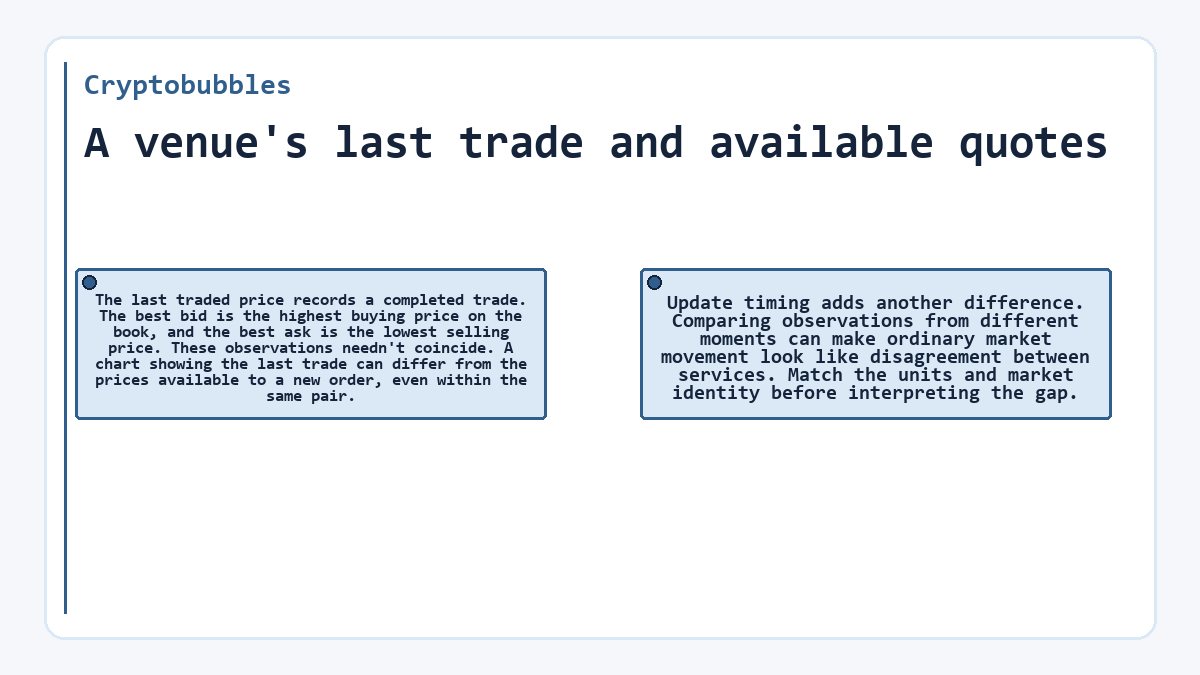
Update timing adds another difference. Comparing observations from different moments can make ordinary market movement look like disagreement between services. Match the units and market identity before interpreting the gap.
Spot markets and derivatives describe different exposure
A spot market concerns an exchange of the cryptocurrency itself, while a futures market concerns a contract whose value follows an underlying asset. The same coin name can appear in both contexts. A derivatives position doesn't by itself establish ownership of the underlying coin. Contract specifications define quantity units and settlement terms, and perpetual contracts can also involve funding payments. A futures price and a spot price therefore belong to different instruments. For coin availability research, distinguish an asset listing from a derivatives contract that references that asset.
Order books separate turnover from available liquidity
Reported trading volume describes past activity over a period; order-book depth describes outstanding buy and sell orders at particular prices. A coin's overall volume doesn't describe the depth of one selected exchange pair. Coinbase Advanced displays an order book and a depth chart for market-level inspection. The depth chart shows cumulative order sizes across prices.
Orders can change before a new order arrives. A larger market order may match several price levels, producing a different average execution price from the last trade.
Can a displayed coin be unavailable for trading at the destination?
Yes, a coin can appear in research data or on an exchange information page while its trading availability remains restricted by listing status, product access, or account eligibility. A visible chart doesn't resolve those conditions. The affected pair's status determines what activity its order book permits.
Coinbase's crypto listing rules distinguish several trading states. Transfer Only permits incoming transfers without placing or filling orders on the new book. Limit Only permits matching limit orders while excluding market orders. Cancel Only permits cancellations but prevents new orders and fills. These states apply to the affected order book, rather than establishing a universal rule for all markets.
Regional restrictions and verification requirements can further affect access. Availability also differs between a venue's products. A public asset page can remain useful for research even when the account cannot trade its associated market.
Fees belong to the selected exchange product
The receiving exchange's product determines how costs appear, so a chart price alone can't establish the total cost of a purchase. Coinbase's simple buy and sell quotes include a spread, with applicable fees shown in the trade preview. Coinbase Advanced uses an order book without that added quoted-price spread; trading fees and the market's bid/ask spread still matter. For simple buys and sells, Coinbase's fee calculation can depend on payment method, order size, market conditions, location, and the selected asset. A link to the exchange doesn't make those product-specific costs interchangeable or permanent.
Keep the market identity with your research notes
A useful record ties the coin to the exact venue, trading pair, and product that you examined. Keep the observation time beside any price or liquidity detail. That makes a later comparison understandable without treating an earlier value as a standing offer. An exchange name alone can encompass multiple products and markets with different conditions. Pair notation supplies a durable relationship between units. Prices, available depth, listing states, and fees are live market or service parameters whose earlier values don't establish future availability.
A different quote currency, product, or account region requires a fresh comparison using that destination's market conditions.
Cryptobubbles: common questions
Is a ticker enough to identify the coin on a linked exchange?
A ticker alone doesn't reliably identify the intended asset or instrument. Short symbols can overlap, and the same instrument can use different symbols across venues. Match the full asset description with the selected market. For a token, its network and contract identity may provide additional distinctions where the destination publishes them. A similar name or logo doesn't resolve a different asset identity.
Will following an exchange link transfer my cryptocurrency?
Opening an ordinary exchange link doesn't transfer cryptocurrency. It navigates to a destination that can provide coin information or a trading interface. A transfer requires a separate instruction through the relevant wallet or exchange account, including the applicable destination details and authorization. Opening a market page, submitting an order, and transferring an asset are distinct actions, with different results.
Can a linked exchange page open in an installed mobile app?
A supported link can open an installed app when the operating system routes that destination to it. The result depends on the link, the app's supported destinations, and the device's handling preferences. Other links open in a browser. Installing an exchange app doesn't guarantee that every coin link opens the intended market inside it, or that the account has access to that market.
Does an exchange listing guarantee withdrawal support for my network?
An exchange listing doesn't establish support for a particular withdrawal network. Trading availability and funding methods describe different capabilities. The exchange's withdrawal options identify the networks that it supports for the selected asset, along with applicable fees and minimums. The receiving wallet must support the chosen network, because an incompatible transfer can result in lost funds.
Why do linked charts show different daily percentage changes?
Daily percentage changes can differ when charts use different reference times or market feeds. A rolling daily comparison and a change measured from a previous daily bar needn't begin at the same instant. TradingView's watchlist change uses the previous daily bar, and exchange time zones can differ. Compare the reference period alongside the venue and pair before treating different percentages as a data error.